How To Grow Onions – From Planting to Harvest
Onions are one of the most exciting things to grow and are actually quite easy to raise. In this post I will walk you through How to Grow Onions – From Planting to Harvest in several easy steps. I’ve also included tips on where to source onions to plant, when to harvest, and how to store onions through the winter.
How to Grow Onions – From Planting to Harvest right in your own backyard!
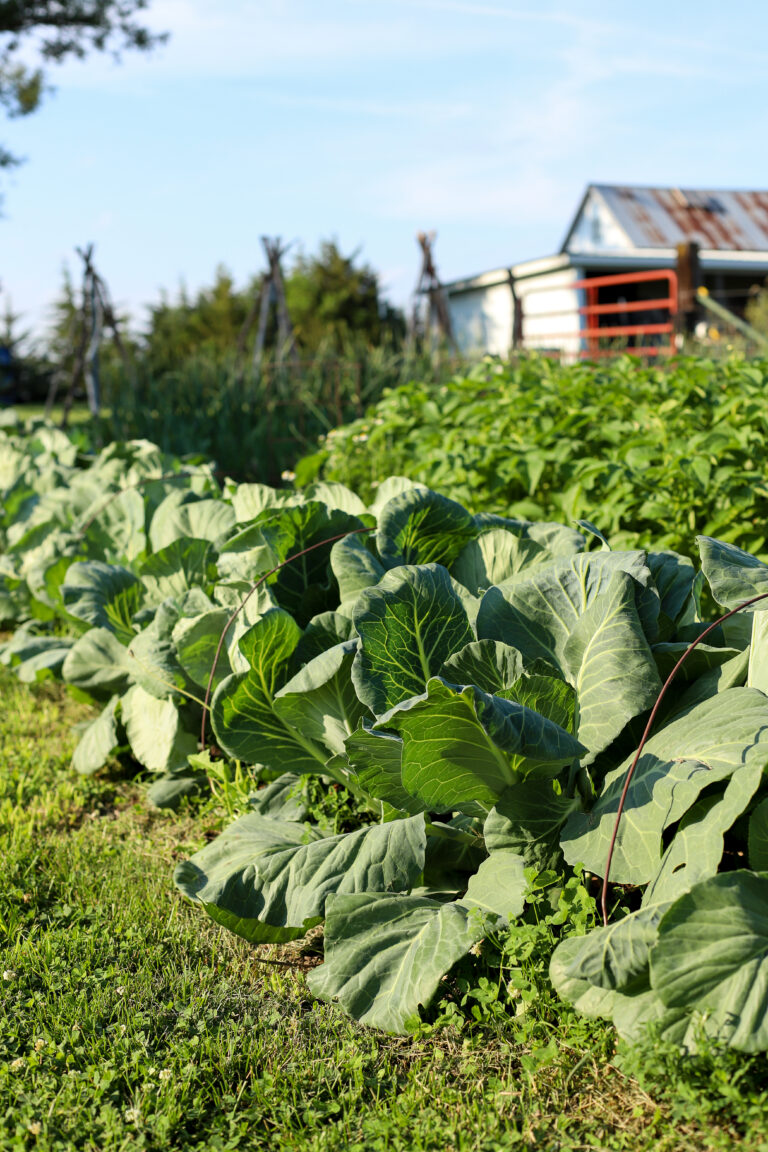
I have been planting and growing onions in my garden for several years now. They are actually one of my most favorite things to grow as they require almost zero maintenance and look so clean and neat in their tidy little rows. Because I love it so much, I decided to share with you, How to Grow Onions – From Planting to Harvest.
Can you tell I like orderly little rows in my garden? When I plant onions I feel like such a professional simply because of how perfect they look growing there.
With a few simple tips you will be on your way to growing big, beautiful onions in your own garden!
In this post I will walk you through:
- Sourcing onion plants
- Choosing the right onion for your zone
- Tools
- Preparing your soil
- Planting onion plants
- Caring for onions during the onion season
- Troubleshooting
- When to harvest onions
- How to cure onions for storage
- Storing onions for the season
- How to use your onions for extended storage life
Grow your own onions and never buy them at the store again!
I am slowly making my way towards growing as close to 100% of my food right here in my very own back yard. Maybe you are too?! Onions and potatoes were the easiest place for me to start because they require hardly any maintenance during the growing season AND they do not need to be preserved right away (like tomatoes or cucumbers) and store well in cold storage. I can now proudly say I haven’t purchased a single onion in 3 years. I’ve also been making my own onion powder. It is seriously better than any onion powder you have ever tasted! (more on this later!)
Let’s get to growing and learn How to Grow Onions – From Planting to Harvest!
Plants, Sets, or Seeds?
The choices seem overwhelming. Well, the confusion stops right here. If you desire to grow large onions that store well, I suggest purchasing onion plants or growing your own from seed. These can be found seasonally at your local greenhouse or grocery store and seeds can be purchased locally or online. I prefer to order plants online so that I am guaranteed a shipping date for my growing zone.
My favorite place to buy onion plants is from Dixondale Farms. This post is in no way sponsored. They just have the best selection in my opinion. Onion plants will ship directly to your mailbox just in time for planting according to your zone. It is best to order onions as soon as possible to ensure you will be on the list to receive your desired variety.
What onion variety is best for my zone?
There are three types of onions that grow best depending on where you are located and what amount of daylight length you experience. Long Day, Short Day, and Intermediate Day.
Long Day Onions
Long day onions grow best in northern states that have between 14-16 hours of daylight length. Onions are best planted in the early spring and harvested mid summer.
Short Day Onions
Short day onions grow best in southern states when daylight length reaches 10-12 hours. Onions can be planted in the late fall through early spring.
Intermediate Day Onions
Intermediate day onions grow best in the middle states, reaching slightly into both the northern and southern states and require at least 12-14 hours of daylight. Onions can be planted in the very early spring.
Storage Length
It is also important to note that different varieties of onions will have longer or shorter storage life. Some onions only last a couple of months in storage while others can last 8 months to a year. Be sure to check this criteria when choosing which variety would be best of your needs.
Unsure what zone you may be in or what onions would work best for your needs? Dixondale Farms has a great reference map to see which area your state falls in.

Join us for coffee on the porch!
Join us on the porch for our Substack newsletter and get our newest recipes straight to your inbox. This is a biweekly email for women, wives, and mothers who desire to cultivate homemaking skills, nurture healthy families through homegrown and homemade food, and grow in grace & godliness in the places God has us.
What tools do you need to plant onions?

- Rake: I use a rake to remove last years leaf cover off of the surface of the row. It also comes in handy when spreading compost evenly over the row.
- Potato fork: I use a potato fork in place of a broad fork (I don’t own one yet!) to loosen soil. This brings oxygen down into the soil and loosens it for planting.
- Dibbler: My dad made me this 4 hole dibbler. Each hole is 5″ apart on center. It helps you to make quick holes with evenly spaced plantings and rows. It really is a time saver!
Prepare your soil to nourish growing onions! This is a vital part in our lesson on How to Grow Onions – From Planting to Harvest
Soil preparation is key to growing anything well. Healthy soil has a huge impact in not only the health of your plant and the size of your harvest but also on the nutrient density of what you are growing.
Soil microbiome is a wild and beautiful thing created by our amazing Creator and is worth taking care of. There is a vast network of microbial life in the soil, smaller than the eye can see. Their role is to break down nutrients and to assist the plant by finding the minerals the plant needs. It then ushers these nutrients to the plant so that the plant can then take up nutrients and grow into a vibrant plant full of healthy fruit. We need to be giving this microbial life the food it needs to feast on so that this little life under our feet can stay happy and healthy.
It really is quite simple to make vibrant soil. Just feed it! All throughout the year you can be nourishing your soil by adding grass clippings, leaf mulch, cover crops, or compost. Any time you add decaying or composted matter on top of your soil you are sending a high-end meal (plus dessert!) down to your garden besties to feast on.
My favorite method for happy and healthy soil! It’s EASY!
My favorite way to prepare the garden soil for my onion plants is to loosen the top layer of soil slightly and then cover my garden bed with a layer of compost. At this time I do not make my own compost. While I would LOVE to do that some day, I purchase compost from the hardware store. It just works out well for me for now.

Since it’s the early spring, my garden is still covered up from its long winter rest. I follow no till gardening methods, meaning I keep my soil covered with something at all times- whether that’s leaf mulch, grass clippings, old hay, or compost. This is how I constantly feed the soil, something is always breaking down and feeding those microbes.
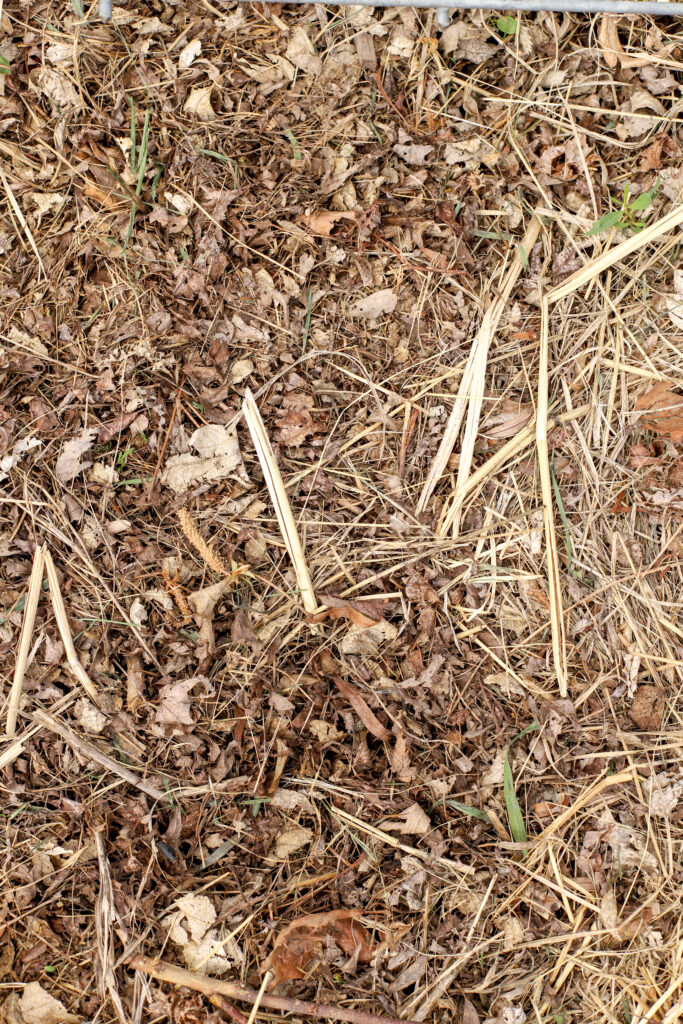
In this case, my garden has been covered in a nice cozy blanket of leaf mulch all winter long. It’s time to rake it away into the walking path and put on a layer of compost. Note: raking the leaves into the walking path means I’ll also have the bonus of a weed free walking area. It’s a beautiful way of doing things.


Then, using a potato fork (or broad fork if you have one) I loosen the top layer of soil. I don’t turn it over, I simply insert the fork and slightly lift it up.

And finally, I spread at least 1″-2″ of compost evenly down the row. This will feed the soil all season long and keep those onions growing strong!
Step-by-Step instructions to plant onion plants:
After the soil is prepared for the growing year, it is time to get those onion plants in the ground.
I like to use this homemade dibbler to grid out my onions. I space my onions about 5″ apart on center, leaving plenty of room for onion bulbs to expand throughout the growing season.


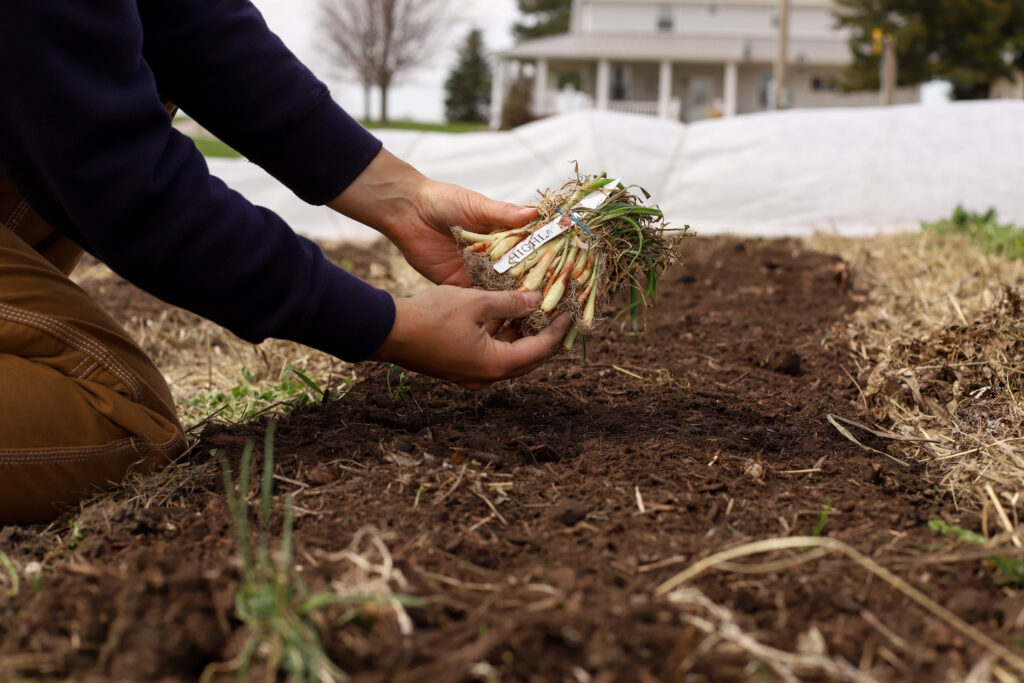
Insert onion plants about 1″ deep into a small hole and then pinch the soil gently around each plant to secure. This is the most tedious part of planting onions but it is so worth it once those tidy little rows appear.


How do you care for onions during the growing season?
Onions are quite easy to care for and only require a few things to keep them happy:
Nutrients. Onions are heavy feeders and require robust soil to form large bulbs. Composting before planting will ensure your onions grow nicely. Many people purchase fertilizers to feed during the season however I have never done this. I believe feeding microbial life is key to healthy plants. In my opinion, fertilizers tend to act like an energy drink rather than a nutrient dense meal. I choose to maintain my soil health rather than quick fix additives.
Water. Onions LOVE water. They love, love, love water. Onions loathe dried out soil and tend to bolt if left to dry out too long. (This will cause the bulb of the onion to not mature properly) Most summers in my area tend to be quite dry. Depending on how hot and dry your area gets, I choose to water my onion plants every 2 or 3 days if they’re not receiving any rain. I do not want my soil soggy so that fungal issues occur. Let the soil dry out between watering, but never let a large amount of time pass without watering the onions.
Weed Control. If left too long, weeds can cause serious damage to your growing onion. Weeds can impact the size of your onion bulb. Removing weeds that have overgrown can also cause damage to your delicate onion roots. Make sure you are consistently weeding before things get out of hand. (I know, it happens fast!) Consider mulching with grass clippings to slow down weed growth.

Common problems when growing onions:
While onions are seriously one of the easiest things to grow, there are a few things to keep in mind. Here are some common problems you might encounter when growing onions and how to deal with them.
Pests–
Racoons and deer especially LOVE to dig up my onion plants. This only happens a few times early in the year but it is still enough to drive you crazy. The best solution I have found for this is to nightly spray a product called Liquid Fence around the garden. It smells TERRIBLE but it works.
Bolting-
Onion growers do not want their onion plants to bolt. This is when a large flower stem grows out from the onion plant. Onions tend to bolt due to stress and this is usually caused by fluctuations in their environment. Keeping growing onions evenly watered will drastically help. I have never had an onion bolt when keeping it consistently watered.
Mushy Onions-
This year we have received an unseasonable amount of rain- while we usually have a wet spring and dry summer, we have received rain at least once a week during the growing year. Many times it rained almost every day. This year I encountered many mushy onions, they simply rotted away in place. While I can’t control the weather, I can keep an eye on my growing onions. As soon as my onions started to “flop” meaning they were ready for harvest (more on this in a bit) I harvested them right away. Onions that are done growing should not be left in the garden long, especially if rain is expected. This will ensure you don’t lose many onions due to excessive rain.

When is the right time to harvest onions?
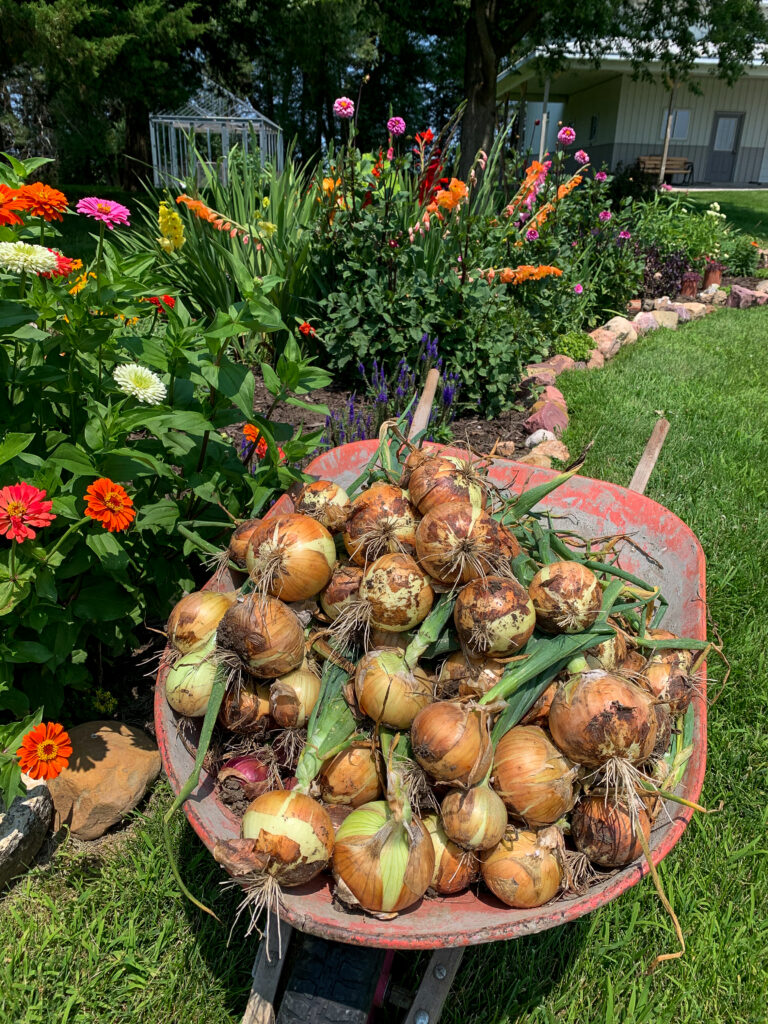
As soon as onions are done growing you will notice their green tops starting to fall over. I call this flopping. Their once strong green tops will be easily knocked over in the wind. You may notice the green tops turning slightly yellow. Bulbs will be large and popping out of the ground. When you see at least 1/2 of the row flopping, its time to have a harvest party. You have successfully learned How to Grow Onions – From Planting to Harvest!

How to cure onions for storing:
Curing onions is very simple and it is a crucial step if you desire your onions to store well for any length of time.
Onions you purchase at the store have thin, crisp paper several layers deep around the onion. This is what happens when you allow onions to cure in a dry location with lots of airflow.
I built this simple rack with chicken wire shelves that allow me to lay onions in a single layer. I put the shelf under the covered portion of our shop porch and allow them to cure for 1-2 weeks. The green tops dry and a nice dry paper forms around the onion.


How to store onions – even if you don’t have a root cellar!
Once the onions have cured, trim off tops and roots and they are ready to store!


I love these collapsible storage crates!
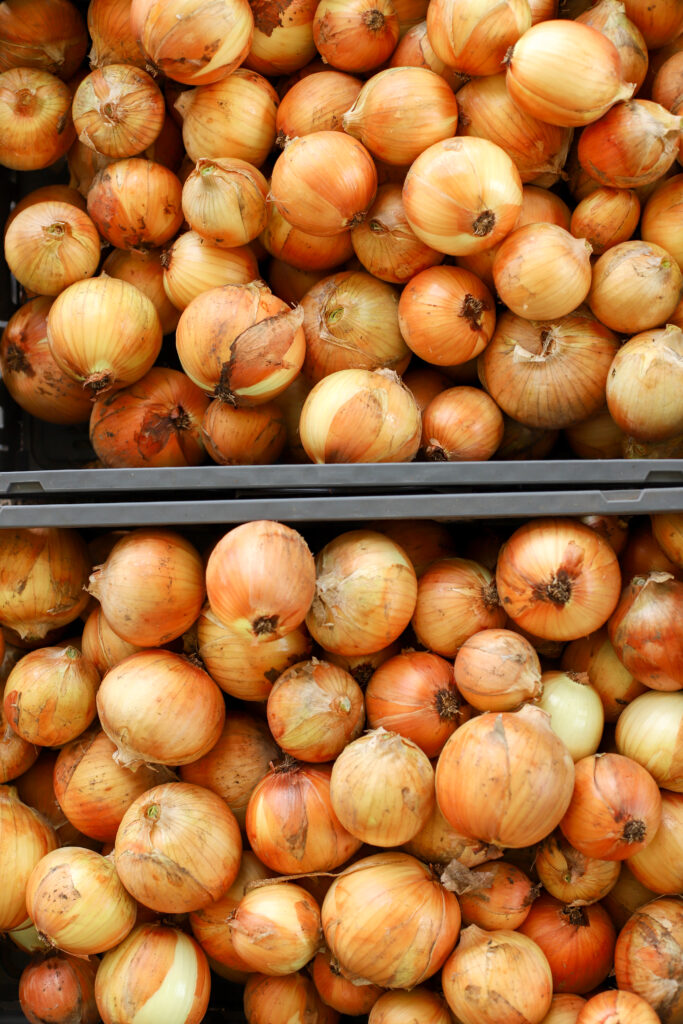
These collapsible crates are great to use for storing onions. I purchase onion plants that have a longer storage length and have found that in a cool and dark location in my basement they store well for generally around 6 months. I go through them several times a month to make sure none are going bad.

My absolute favorite way to extend the life of the onions I have grown is to dehydrate them! There is seriously nothing that has better flavor than a homegrown dehydrated onion. I am hoping to have a tutorial for dehydrating onions coming soon!

Happy growing!
This is How to Grow Onions – From Planting to Harvest in a easy step by step guide. I would love to hear how this helped you grow the best onions every!